About Me
Hello! My name is Kaitlynn and I am a graduate from the University of Nevada-Las Vegas, where I earned degrees in Computer Science and Kinesiology. Over the past 3 years, I've honed my programming skills in C++ and Python, applying them to develop innovative solutions in both academic and professional settings. Since graduating, I have worked as a Project Management Coordinator and a Platform Engineer, expanding my technical toolkit and leadership experience. I'm excited to continue using my technical and creative skills to build impactful, user-focused solutions.
-
Programming Languages:
C++, Python, HTML/CSS, JavaScript, MATLAB, Ruby -
Certificates:
AWS Cloud Certified Practitioner -
Libraries/Frameworks:
Node.js, React, TensorFlow, Pandas, Scikit-learn, PyTorch, Matplotlib -
Tools:
Git, Github, Visual Studio Code, Figma, Jira

Projects
Robotics Software Developer Internship
.png)

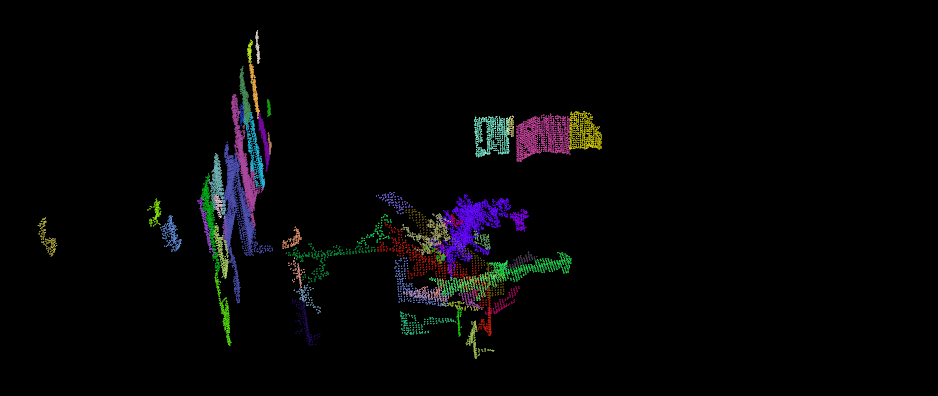
Project Overview:
During my internship, I collaborated with a team to develop an autonomous robot designed to be equipped with a pressure washer system for cleaning pool decks. Our primary challenge was to design a navigation system that could effectively maneuver around obstacles while ensuring complete coverage of the area.Key Contributions:
- Area Coverage Algorithm: I developed an area coverage algorithm in C++ using the A*
Search
method to enable efficient robot navigation, obstacle avoidance, and cover a defined
area.
The algorithm was integrated with Madara Middlware and utilized sensor data from Mid-360
LiDAR and Emlid GNSS.
This methodology to use A-Star was inspired by academic research found here: Article
To View a Simplified Version: Area Coverage Algorithm
- LiDAR Integration for Object Detection: I utilized LiDAR to capture point clouds and applied plane segmentation to identify flat surfaces. Using the PCL (Point Cloud Library), I extracted Euclidean clusters to group objects and determine their locations on a 2D grid map. This approach enabled effective object detection and localization for the autonomous robot.
- GPS Waypoint Generation: We integrated a GPS system using the Emlid Reach RS3 to accurately capture the latitude and longitude of objects. The receivers tracked the robot's location, which allowed me to convert the LiDAR Cartesian coordinates into GPS coordinates. This data was then combined with the area coverage algorithm to enable precise waypoint navigation.
Tools:
- Mid-360 (LiDAR): LiDAR sensor for high-precision 3D mapping.
- Emlid Reach RS3: GNSS receiver for accurate positioning.
- Reach M2 LoRa Radios: Long-range communication system for data transmission.
- NVIDIA Jetson Orin: AI computing platform for real-time processing and analysis.
- Programming Language: C++
- Cmake: Used for building and testing our project.
- Madara Middleware (madara.ai): Middleware for multi-agent systems and autonomous applications.
Custom Bug Ticket Creation and Tracker
Project Overview:
This project contains a Forge app that displays in a Jira issue panel. It shows a table of related bug tickets and includes a custom "Create Ticket" button. The primary goal of this app is to streamline bug tracking while preventing clutter on the main project board.
The main board is reserved for system-wide or project-level bugs, not for minor issues like fixes related to individual tickets (e.g., feature enhancements or small improvements). Previously, the quality analysis team would document these smaller issues by leaving comments on the original tickets. This approach made it difficult to track workload and manage bug resolution effectively.
Additionally, Jira automation was not a viable solution. It does not support a rich text editor in ticket descriptions and does not automatically open the newly created ticket. This adds extra manual effort for the QA team, who must locate the ticket afterward and manually add screenshots or apply formatting.
This app addresses that pain point by providing a custom "Create Ticket" link that preloads the necessary fields and opens the ticket creation page directly.
To view Project: Forge Bug Tracker - Issue Context
Key Contributions:
- Built the app using JavaScript, React, and Node.js within the Atlassian Forge framework.
- Implemented a dynamic Jira issue panel and issue context to display a table of related bug tickets.
- Added a "Create Ticket" button that opens a modal for users to type a new ticket summary. It will automatically create a ticket in a new tab, reducing manual effort and enabling rich text editor.
- Integrated a custom field (Issue Picker) to link bug tickets to the main issue and auto-populate the related bug tickets table.
Tools:
- Languages: JavaScript, HTML, CSS
- Frameworks/Libraries: React, Node.js
- Platform: Atlassian Forge (Custom UI)
- Jira REST API
- Version Control: Git, GitHub
Freshdesk AI Summarizer
Project Overview:
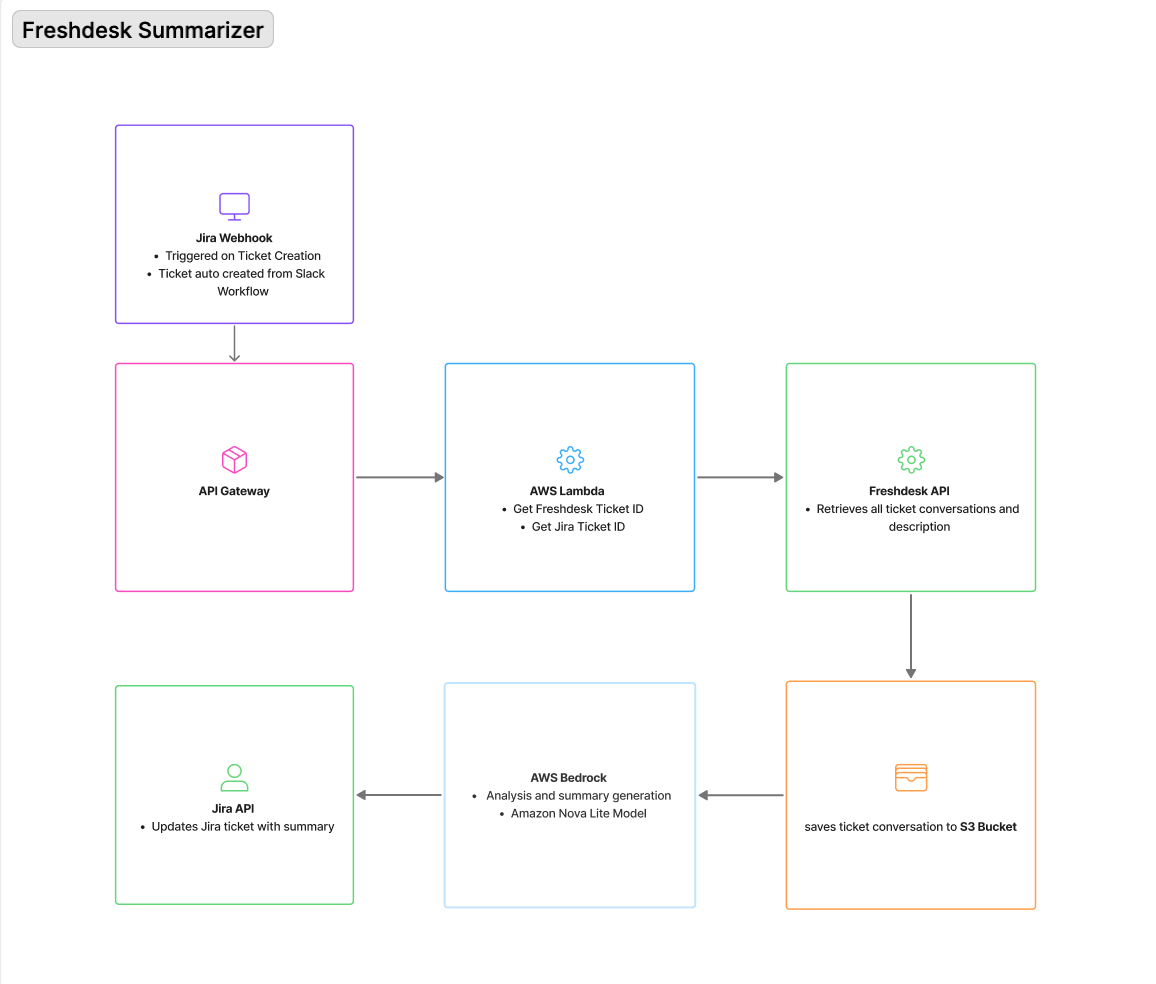
This AWS Lambda function, written in Ruby, automatically summarizes Freshdesk support tickets to assist engineers with troubleshooting. The function is triggered when a new troubleshooting ticket is created in Jira and generates an AI-powered summary using AWS Bedrock based on the ticket's associated Freshdesk conversation. By automating the summarization process, this workflow helps engineers quickly understand the context of customer issues without manually reviewing the full conversation history.To view Project: Neural Network Model Project
Key Contributions:
- Designed the end-to-end workflow connecting Jira, Freshdesk, AWS Lambda, Amazon S3, and AWS Bedrock to automate ticket summarization.
- Developed the AWS Lambda function in Ruby to process webhook events, retrieve ticket data, and orchestrate the summarization workflow.
- Integrated the Freshdesk API to retrieve full conversation histories and the Jira REST API to update troubleshooting tickets automatically.
Tools:
- Programming Language: Ruby
- AWS Services : AWS Lambda, AWS Bedrock, S3 Buckets, API Gateway
- APIs & Integrations: Jira REST API, Freshdesk API, Jira Webhooks
- Version Control: Git, GitHub
Classification Using a Neural Network Model
Project Overview:
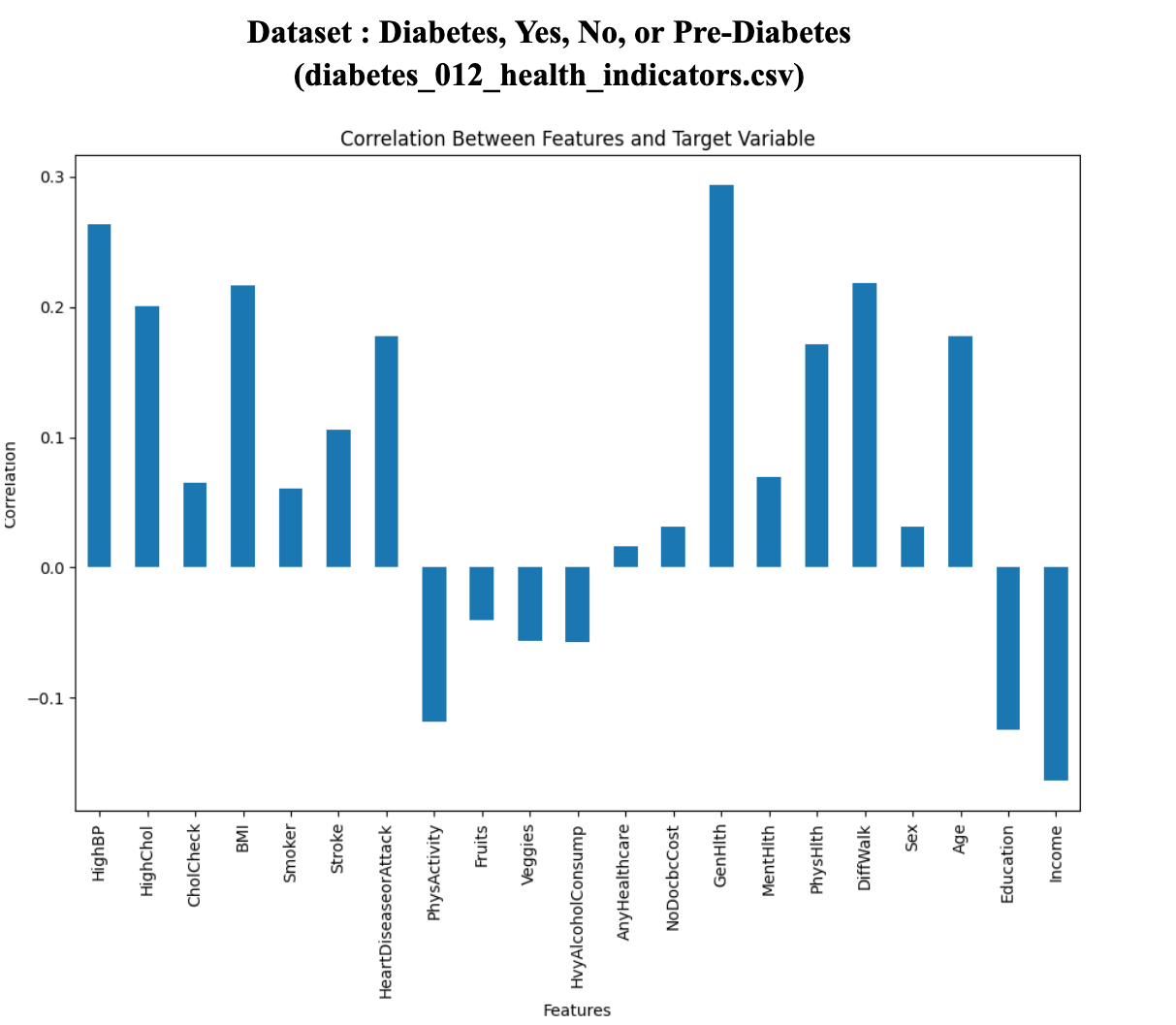
For this project, I collaborated with a team to develop a neural network model aimed at predicting whether an individual has diabetes. Our goal was to determine if we could reliably predict diabetes based on various health, lifestyle, and socioeconomic factors. The dataset we used categorizes individuals into three groups: diabetes, pre-diabetes, and healthy. It also includes a range of features for each individual. The model was able to achieve an average accuracy of 85% in predicting diabetes.To view Project: Neural Network Model Project
Key Contributions:
- Conducted correlation analysis and created visualizations using Python and Pandas to analyze the relationships between key features, helping guide feature selection and model development.
- Leveraged PyTorch for training the neural network model, and used Matplotlib to visualize the training vs. validation accuracy and training vs. validation loss over 500 epochs. These visualizations provided valuable insights into model performance, helping identify potential issues such as overfitting and underfitting.
Tools:
- Programming Language: Python
- Libraries: Pandas, PyTorch, Scikit-learn, Matplotlib